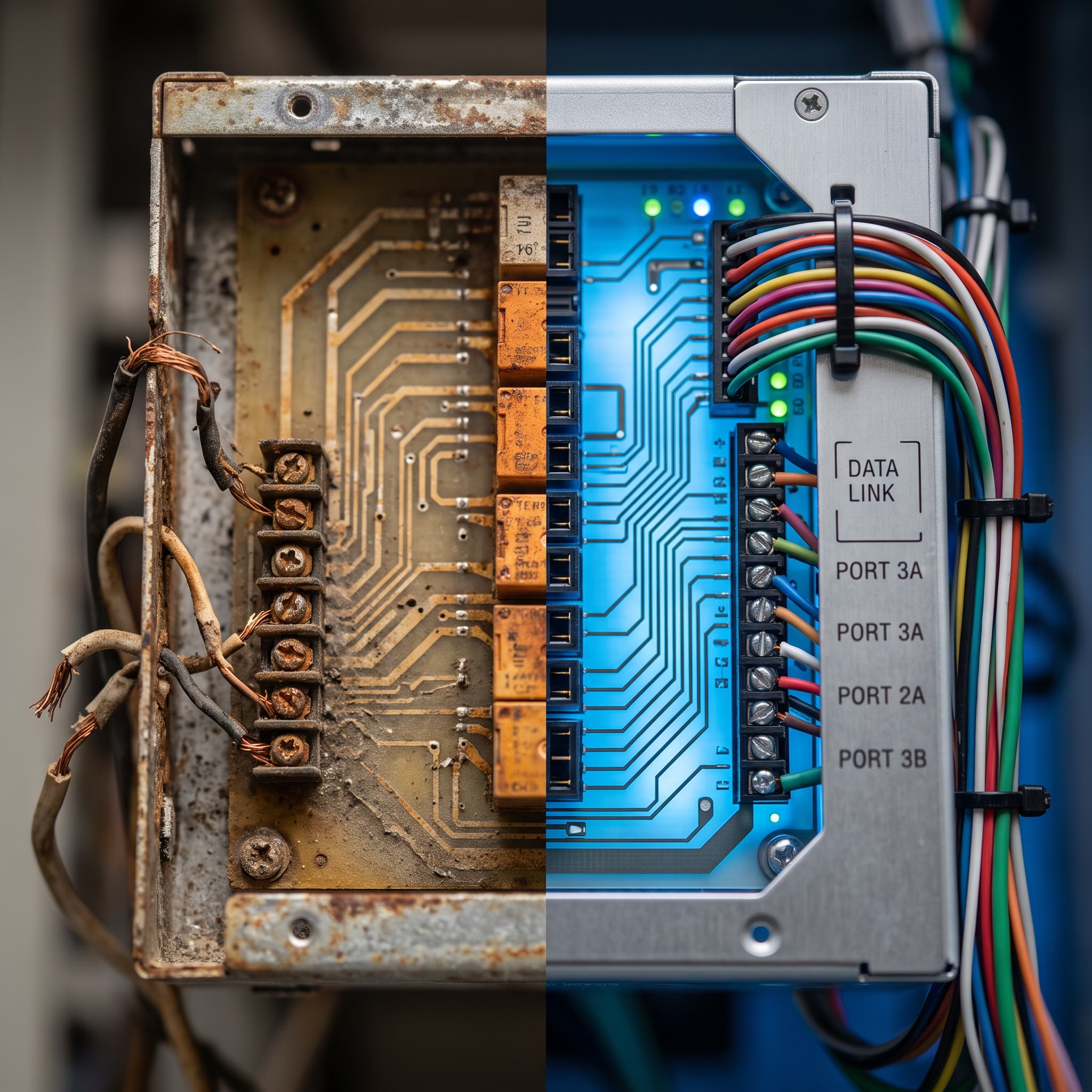
Public safety agencies are hearing the same message from every direction: AI is coming to dispatch operations, and the smart move is to get your people ready for it. That advice is right. It is also only half of the picture.
The Upskilling Conversation Is Half the Conversation
Cybersecurity leader Dan Lohrmann made the case in a recent Government Technology piece (How to Upskill for Cybersecurity and Stay Ahead in the Age of AI) that AI will not replace skilled professionals so much as reshape their work. His prescription: master the tools, strengthen the judgment and critical thinking that only humans bring, and build governance so autonomous systems stay accountable.
For agencies, that translates into a familiar plan. Get the latest AI tools that support public safety operations. Send dispatchers and analysts to training. Build AI literacy across shifts. Write policy before the tools arrive. All of it is worth doing.
But there is an assumption buried in the upskilling conversation that deserves daylight: it assumes the systems your people return to can actually do what the training promised.
Trained People, Constrained Tools
You would not train a dispatcher on advanced call-handling and then hand them a radio that cannot carry the call through. The training was real, but the system was not built to support it.
The same mismatch happens quietly with AI. An agency invests in its people, and those people come back ready to apply AI-assisted triage, smarter call handling, or faster incident analysis. Then the tools meet the system of record. If the CAD platform underneath cannot share data cleanly, cannot connect to the tools your people were trained on, and cannot scale when demand spikes, the new skills have nowhere to go.
Upskilling your people while leaving the foundational architecture alone is only sharpening one side of the blade.
This is not an agency failure. Public safety organizations are not behind on AI because they lack effort or commitment. Most dispatch software was simply designed around legacy environments and procurement checklists, not the realities of live incidents, and certainly not with AI in mind. The constraint lives in the architecture, not in the people.
What AI Actually Needs From the Foundation
AI is a force multiplier, and it multiplies whatever it is sitting on. Layered onto a modern foundation, it compounds your team’s strengths. Layered onto a system that was never built for it, it inherits every limit that system already has. In practice, AI capability in dispatch operations depends on a short list of architectural realities.
Accessible data. AI is only as useful as the information it can reach. Incident history, unit status, and call data locked in silos or aging on-premises servers are invisible to the tools your people want to use.
Real-time flow. Dispatch decisions happen in seconds. AI support that depends on batch exports or overnight syncs arrives after the moment it was supposed to serve.
Open integration. New capabilities should connect to the platform, not bolt onto it. An architecture built for integration lets an agency add AI tools as they mature without ripping anything out.
Room to scale. Peak demand is exactly when AI assistance matters most, and exactly when constrained infrastructure gives out. Cloud-native systems hosted in AWS GovCloud scale with the incident, not against it.
The Questions Worth Asking Before You Adopt
Agencies asking hard questions about their foundation before adopting AI are asking exactly the right questions. A few worth putting to any vendor, including us:
Where does our data live, and can an approved tool reach it in real time? What happens to system performance when call volume doubles? When a new AI capability proves itself two years from now, what does connecting it look like? And does the platform update continuously with no downtime, or does every improvement mean a maintenance window?
The answers tell you whether an AI investment will compound or stall. They also tell you whether the upskilling investment in your people will pay off, because trained judgment deserves tools that can keep up with it.
Frequently Asked Questions
Common questions about AI readiness and CAD architecture.
QDoes adopting AI mean replacing our CAD system?
No. AI capability means giving your team more tools they can reach when they need them, not replacing the system or the people running it. The real question is whether your current CAD platform can support those tools: accessible data, real-time information flow, and open integration. If it cannot, that is a foundation question, not a staffing question.
QShould we train our people before or after modernizing the system?
In parallel. Skills development takes time, and so does thoughtful procurement. The mistake is treating them as separate initiatives with separate owners. The value shows up where they meet.
QHow does cloud-native architecture change what AI can do for dispatch operations?
Cloud-native CAD keeps data accessible and current, connects to new tools through modern integration, and scales with demand. That is the environment AI capabilities are built to work in. It also means the platform is continuously updated with no downtime, so new capabilities arrive without maintenance windows.
10-8 Systems builds cloud-native CAD for the agencies doing both halves of the work: developing their people and demanding a foundation that can keep up. If you are weighing what AI readiness really requires, we are glad to talk through it.