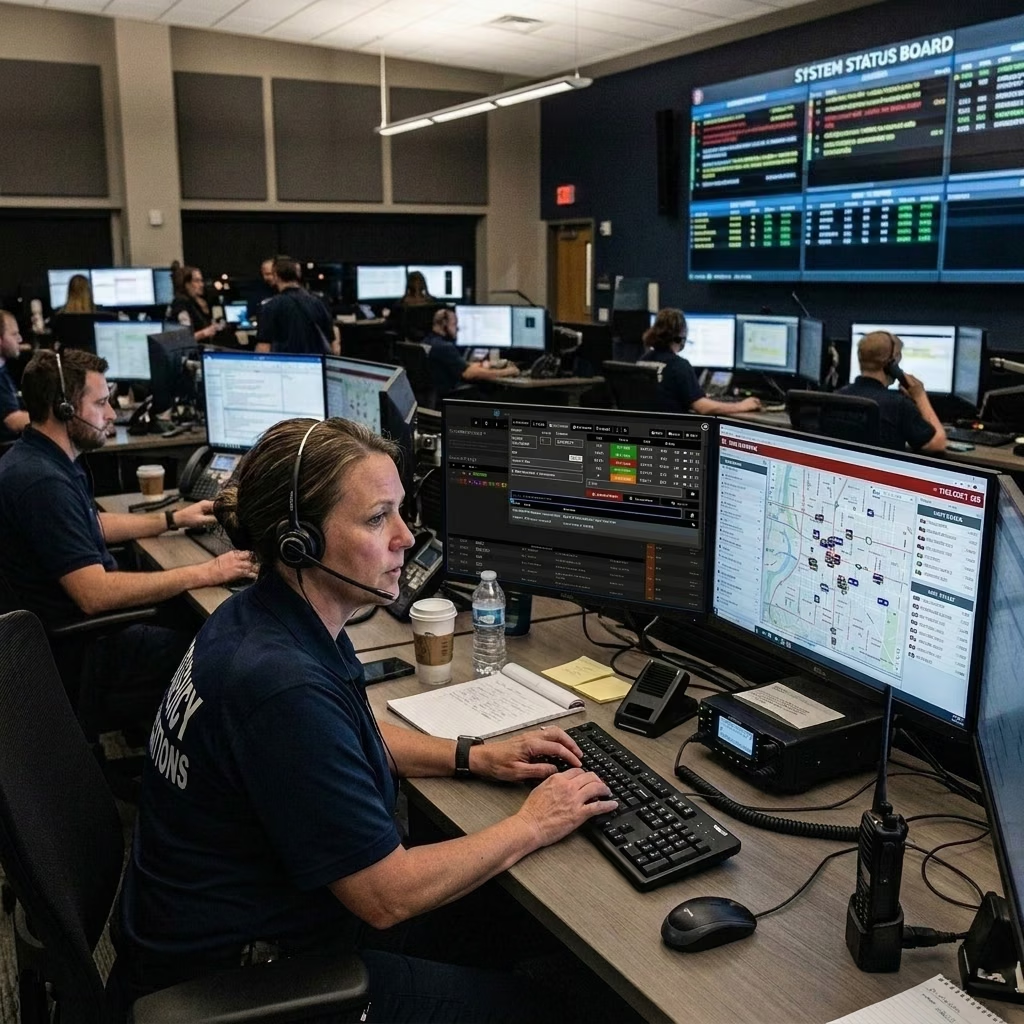
Choosing a Computer-Aided Dispatch (CAD) system is one of the most important technology decisions a public safety agency can make. CAD sits at the center of dispatch operations, field response, incident coordination, reporting workflows, and real-time situational awareness. That makes the evaluation process critical.
But too often, CAD evaluations start and end with feature lists. Agencies compare modules, check boxes, attend demos, review pricing, and try to determine which system appears to offer the most functionality on paper.
Features matter, but they do not tell the whole story.
A CAD system is not proven in a controlled demo. It is proven during peak call volume, complex incidents, severe weather, staffing constraints, multi-agency coordination, system updates, implementation, and the daily realities of dispatch operations.
The better question is not simply, “What does the system include?” It is, “How will this system perform when our agency needs it most?”
The Demo Is Not the Real Test
A vendor demo can be helpful, but it usually shows a CAD system under ideal conditions. The workflows are clean. The scenario is controlled. The system is being presented by people who know exactly where to click, what to show, and how to avoid the operational friction agencies may experience later.
That does not mean demos are unhelpful. It means they are incomplete.
Public safety operations do not happen in ideal conditions. Dispatchers work under pressure. Calls stack up. Units move quickly. Information changes in real time. Severe weather, large-scale incidents, mutual aid events, and staffing challenges can all place pressure on the system and the people using it.
That is why agencies should evaluate how a CAD system performs under real operational strain. Does it remain responsive during high call volume? How does it handle major incidents? What happens if connectivity is disrupted? What failover and continuity measures are in place? How often is the system updated, and how are those updates managed? Reliability is not just a technical specification. It is an operational requirement.
A CAD system should help dispatchers move quickly and confidently when the environment is busy, uncertain, or high stakes. If a platform only looks strong in a scripted demo, agencies may not see its limitations until after go-live, when the cost of disruption is much higher.
One of the most reliable ways to close that gap is a trial of the full system, run by the agency’s own staff in their own environment, before any contract is signed. Most providers do not make that possible. 10-8 Systems does.
Look at How Information Moves Across the Operation
CAD does not operate in isolation. It is part of a larger public safety environment that may include mobile users, Records Management System (RMS) workflows, mapping, reporting, analytics, state and federal data requirements, neighboring agencies, and other critical systems. That is why agencies should evaluate how information moves, not just which features exist.
When a call is created, does the right information move quickly to the right people? Can dispatchers, responders, supervisors, records staff, and administrators operate from the same current picture? Are users forced to re-enter information across disconnected systems? Does data move in real time, or does it lag behind the pace of the incident?
These questions matter because fragmented systems create operational drag. Every duplicate entry, delayed update, manual workaround, or disconnected workflow increases the chance that teams are working with incomplete or outdated information.
Interoperability should also be evaluated carefully. Agencies need to understand whether a CAD system can support coordination across the full public safety workflow, including internal teams and external partners where needed.
For some agencies, that means looking for a platform that includes connected CAD, Mobile, RMS, mapping, reporting, and administrative workflows within the same environment. For others, it also means confirming that the platform can connect with external systems when operationally required.
The goal is not integration for its own sake. The goal is better coordination. A strong CAD system should help information move across the operation without forcing people to work around the technology.
Evaluate Fit, Not Just Features
The “best” CAD system is not always the one with the longest feature list. It is the one that fits how an agency actually works.
That includes dispatch workflows, field response needs, reporting processes, supervision, administration, training, staffing models, and local operating procedures. A feature that looks impressive in a procurement document may not create value if it slows users down, requires excessive customization, or does not match how the agency handles real calls.
Usability is especially important in dispatch environments. A system should be intuitive enough to support speed and accuracy under pressure. Dispatchers should not have to fight the interface during a complex incident. Field users should not have to search for critical information. Supervisors should be able to access the visibility they need without relying on manual reporting or disconnected tools.
Agencies should also look at how flexible the system is without requiring heavy custom development. Every agency has its own processes, but too much customization can create future challenges. Highly customized systems can become harder to update, harder to support, harder to train on, and harder to adapt when operational needs change.
Implementation is part of fit as well. A CAD transition affects people, workflows, data, training, policy, and day-to-day operations. Agencies should ask what implementation actually requires, how data migration is handled, what training looks like, and how the vendor supports users before, during, and after go-live.
A smooth implementation is not just about getting the system installed. It is about helping the agency maintain continuity while moving from one operational environment to another.
Think Beyond Go-Live
CAD evaluation should not stop at launch. Agencies are choosing a system that will support mission-critical operations for years, which means long-term viability matters.
That includes scalability. Can the system support more users, more data, more agencies, more reporting requirements, more integrations, or new operational needs over time? Can it adapt as public safety expectations change? Can the platform evolve without requiring the agency to rebuild its technology foundation?
Infrastructure should also be part of the conversation. Agencies should understand what the system requires from their internal IT teams, how updates are handled, how support is delivered, and what operational responsibilities remain with the agency over time.
Total cost of ownership is another important consideration. The initial price of a CAD system is only one part of the investment. Agencies also need to consider implementation, training, maintenance, support, infrastructure, upgrades, integrations, internal IT resources, and the cost of operational inefficiency.
A system that appears less expensive upfront may become more costly if it requires significant local infrastructure, frequent manual maintenance, heavy customization, delayed updates, or additional tools to support basic operational needs.
The right CAD system should support the agency not only on day one, but through future growth, changing requirements, technology shifts, and new operational demands.
FAQ: CAD Evaluation Questions Agencies Should Ask
The questions worth asking before, during, and after evaluation.
QWhat should agencies look for when evaluating a CAD system?
Agencies should look beyond feature lists and evaluate real-world performance, reliability, interoperability, workflow fit, implementation requirements, scalability, support, infrastructure, and total cost of ownership. The right CAD system should support how the agency operates today while giving it room to evolve over time.
QWhy are CAD demos not enough?
Demos are useful, but they usually show the system under controlled conditions. Agencies need to understand how the system performs during high call volume, major incidents, staffing constraints, multi-agency coordination, implementation, and daily operational use.
QHow will a CAD system work for our staff and workflows?
The most reliable way to find out is to put the system in front of the people who will use it, running the work they actually do. A demo shows the platform under controlled conditions. A trial with a full CAD system shows how it holds up against real dispatch workflows, real staffing levels, and the way your agency actually runs calls. Most CAD providers do not offer a working trial of a complete system, which makes genuine fit hard to judge before a contract is signed. 10-8 Systems lets agencies evaluate the full platform in their own operational environment, so the decision rests on how the system performs for the team, not on how it looks in a presentation.
QHow important is interoperability in CAD evaluation?
Interoperability is critical because CAD is part of a larger public safety workflow. Dispatch, Mobile, RMS, mapping, reporting, administration, and partner systems need to share information in real time so teams can operate from the same current picture.
QShould agencies consider cloud-native CAD systems?
Yes, especially when evaluating long-term scalability, system updates, resilience, recovery, and reduced infrastructure burden. The key question is not simply whether a system is cloud-based, but whether its architecture supports operational continuity and future growth.
QWhat is the true cost of a CAD system?
The true cost includes more than licensing. Agencies should consider implementation, training, migration, support, infrastructure, maintenance, upgrades, integrations, internal IT resources, and the operational cost of inefficient or disconnected workflows.
CAD Evaluation Is an Operational Decision
A CAD system is not just another software purchase. It is the operational foundation that supports dispatch, response, coordination, records, reporting, and real-time decision-making. That is why CAD evaluation should go beyond the feature checklist.
Agencies should ask how the system performs under pressure, how information moves across the operation, how well the platform fits real workflows, and whether it can support the agency long after go-live.
The right CAD system is not the one that looks strongest in a demo. It is the one that helps public safety teams operate with speed, clarity, and confidence when it matters most.
10-8 Systems helps agencies think beyond the checklist and evaluate CAD modernization through the lens of real-world operational performance. If your agency is reviewing CAD options or planning for future modernization, contact 10-8 Systems to discuss what a connected, cloud-native CAD environment could look like for your team.