The conversation around cloud in public safety has moved quickly over the past few years. As the National Public Safety Group highlights, the focus is no longer on whether agencies will adopt cloud, but how prepared they are to do so effectively.
That shift has brought a new layer of nuance into the discussion.
Not all cloud deployments are the same.
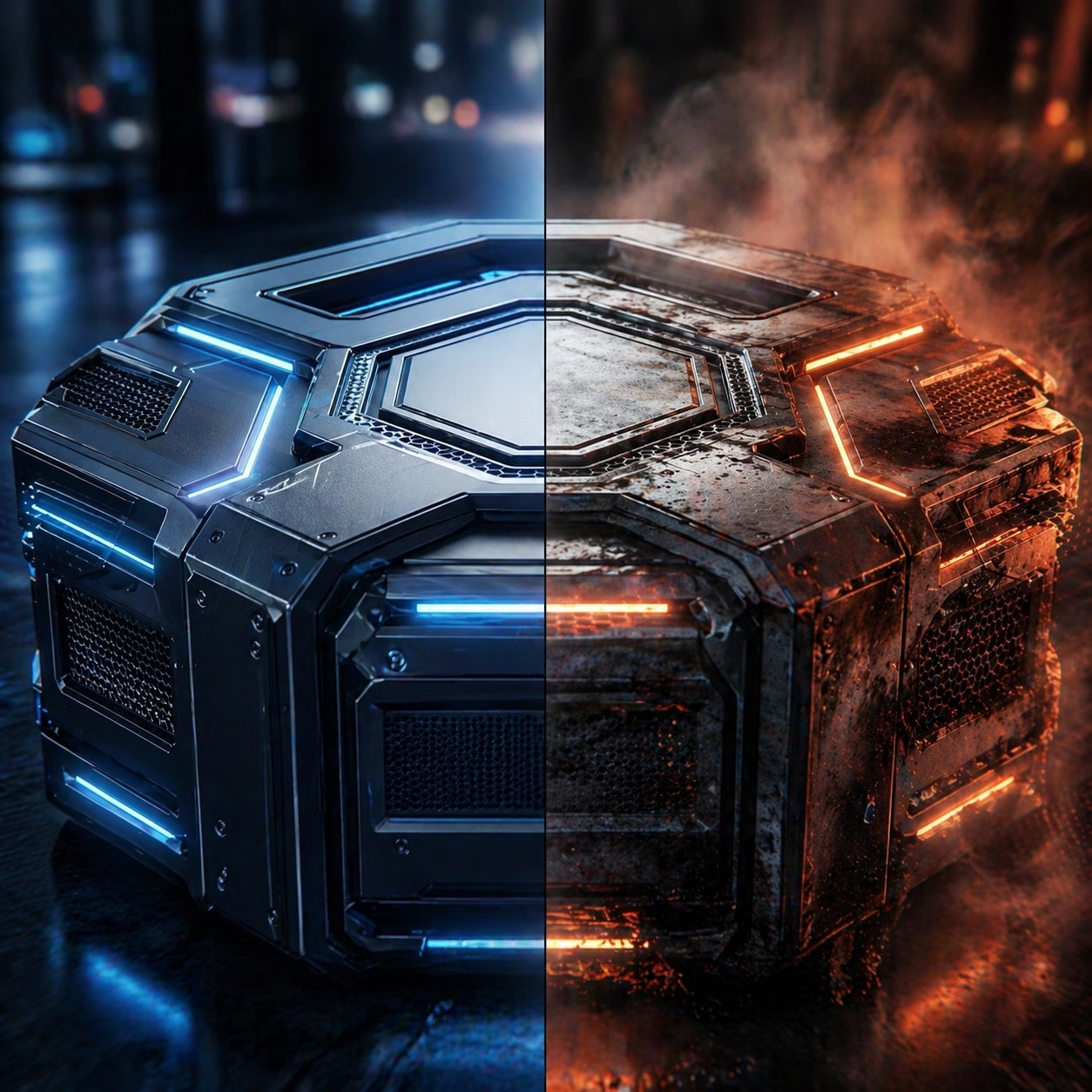
Some CAD systems are designed as cloud-native platforms, built specifically to operate in distributed, real-time environments. Others are legacy systems that have been moved to the cloud, often referred to as “lift and shift.” They may now be hosted in cloud infrastructure, but the underlying architecture and operational complexity remains largely unchanged.
On the surface, both can be described as cloud-based. In practice, the differences become clear under pressure.
How Systems Hold Up During Live Response
The distinction between cloud-native and legacy systems is not about features or where the system is hosted. It shows up in how the system behaves when things are moving quickly.
During active incidents, especially those involving multiple agencies, systems are expected to do more than store and display information. They need to support real-time updates, maintain a consistent operating picture, and allow information to move seamlessly across teams.
This is where cloud-native systems tend to perform differently.
Because they are built for distributed environments, they can handle concurrent activity more effectively. Data is structured to be shared in real time, rather than passed between systems. Updates propagate quickly, and the platform is designed to scale as demand increases.
Legacy systems that have been moved to the cloud often carry forward constraints from their original design. Data may still be siloed or require translation between components. Performance can degrade under load. Workarounds that existed in on-prem environments may still exist, just within a different hosting model.
These differences are not always visible during evaluation. They become apparent when incidents are live, when coordination is complex, and when timing matters.
The Difference Is in How It’s Built
This is where the cloud conversation in public safety actually gets real.
Cloud is not just about where a system runs. It’s about how that system was built in the first place, and whether it was designed to operate in a distributed, real-time environment or simply moved into one. There’s a fundamental difference between a CAD platform designed for the cloud and a legacy one that’s been lifted and dropped into it.
Cloud-native CAD is built to take advantage of scale, real-time data flow, and multi-agency coordination. The other often carries forward the same constraints it had before, just in a different hosting model.
For public safety agencies, that distinction doesn’t show up in documentation or demos. It shows up when things get busy and the system is under real pressure. When multiple incidents are active at once, when agencies need to operate from the same picture, and when information has to move without delay, the underlying design of the system becomes visible very quickly.
That’s the moment where platforms either hold up or start to show their limits.
The move to the cloud is already happening across public safety. What’s less clear, and increasingly important, is how agencies evaluate the systems they’re putting at the center of that shift. Because not all cloud CAD is designed to support the realities of live response, and the difference is not something you can paper over with features.
It shows up in performance, in coordination, and in how reliably the system supports decision-making when it matters most. That’s the standard modern CAD is being held to.
It’s also the standard cloud-native platforms like 10-8 Systems were built to meet from the outset, with real-time, multi-agency response as a core requirement rather than an afterthought.
For agencies looking to future-proof their operations, the question isn’t just whether to move to the cloud, but which systems are built to perform once you get there. 10-8 Systems was designed as a cloud-native CAD platform from day one, with real-time coordination at its core. If you want to understand what that looks like in practice, we’d be happy to connect.