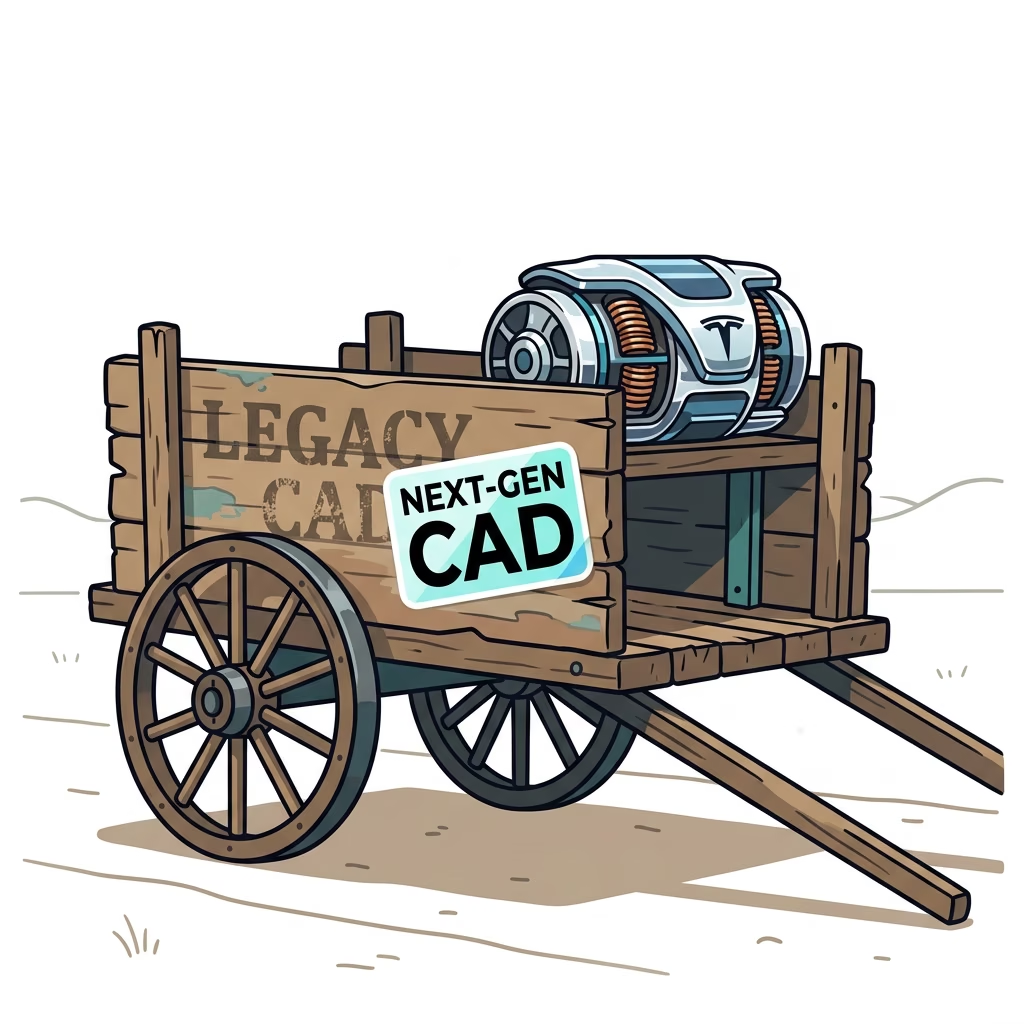
At some point in the last decade, “next-gen” stopped meaning anything. Walk any conference floor or open any vendor brochure and you will find it everywhere: next-gen dispatch, next-gen intelligence, next-gen situational awareness. Every CAD vendor in the market has found a way to work it into a slide deck.
What that phrase almost never refers to is the underlying architecture, because a significant portion of what gets marketed as next-generation Computer-Aided Dispatch (CAD) is still running on physical servers somewhere in your facility, humming away in a climate-controlled room that requires its own maintenance schedule, its own IT coverage, and is its own single point of failure.
The features may be new but the infrastructure underneath them is not, and “next-gen features on legacy infrastructure” is the sentence hiding behind a lot of those brochures.
That gap between what vendors are calling next-gen and what is actually powering it is where public safety agencies get caught.
The rest of the critical infrastructure world made this move a long time ago
Highly regulated industries like financial services and healthcare began moving their critical infrastructure platforms to the cloud in the early 2010s, and defense contractors and government agencies followed close behind. Today, more than 7,500 government entities run on AWS GovCloud alone.
Public safety CAD is one of the last categories of critical infrastructure platforms where running on physical servers in your own facility is still positioned as a selling point rather than a red flag, and that distinction matters more than most agencies realize until something goes wrong.
It is not an infrastructure advantage. It is a major liability with a power cord.
When the building becomes the incident
There is a particular irony baked into on-premise CAD infrastructure that does not get discussed enough: the same events that generate the highest dispatch volume are often the same events most likely to threaten your physical facility. A tornado does not care that your server room is in the basement, and a major fire does not reroute around your building because it houses dispatch.
If something happens to your facility during a mass casualty event, a multi-agency response, or a catastrophic weather incident, your on-premise CAD server becomes another victim of the incident you are trying to coordinate. Your system goes down exactly when it cannot go down, and that is an architectural reality that no feature list fixes.
The infrastructure question that actually matters
Every conversation at today’s public safety conferences is gravitating toward the same place: next-gen technology and AI, from AI-assisted call processing and transcription to automated call logs. Those capabilities are real and the operational value is real, but they are only as good as the infrastructure running them, and that is the prerequisite question nobody is asking first: What is this technology actually running on?
Because if the answer is a decade-old platform architecture held together by bug fixes and patches labeled as upgrades, the next-gen conversation is getting ahead of itself. And before anyone points at the shiny new server in their equipment room: the server is just the box. What matters is the foundation underneath it, and a two year old server running a decade-old platform architecture is still a decade-old platform architecture.
It is a bit like dropping a Tesla powertrain into a horse cart and calling it an electric vehicle. The technology is real, but the platform it’s running on is no longer fit for purpose.

Public safety platforms require continuous updates, real-time data pipelines, and infrastructure that can scale on demand during the moments that matter most, and none of those things are possible on a platform that was designed for a different era and has been incrementally patched ever since. What gets called interoperability on a legacy public safety platform is often a patchwork of custom integrations, manual workarounds, and middleware held together with the operational equivalent of duct tape and string. It functions until something changes, and then it does not.
A modern public safety CAD platform should be cloud-native, scalable, resilient, and built on infrastructure designed to meet federal security and data residency standards. AWS GovCloud exists specifically for this: government-grade infrastructure that keeps sensitive public safety data where it belongs, continuously available, continuously updated, and built to support whatever comes next. That is the prerequisite conversation, and everything else comes after.
What to actually ask before your next CAD conversation
Before you ask what the system can do, ask what it does when everything goes wrong:
- If a major weather event or power outage hits your facility, does your CAD system go down with it?
- If something happens to your facility during an active incident, can your agency keep dispatching from another location without manual intervention?
- When your system goes down, is it a complete outage or are there redundancies that keep you operational?
- When your vendor pushes an update or patch, who controls the timing and does your system go offline to receive it?
- When was the last time a true integration was added to your platform versus a workaround that gets called an integration?
- Where does your data actually live, and what happens to it if your facility is compromised?
- When did your platform last receive a meaningful architectural update, not a feature addition or a bug fix?
If your vendor cannot successfully answer these questions, it is more than likely their system cannot either. A truly cloud-native CAD platform should make most of these questions irrelevant, because automatic failover, geographic redundancy, continuous updates with no downtime, and native interoperability are not premium features on a cloud-native platform. They are the baseline, and if your current system cannot clear that bar, the conversation is not about features. It is about the foundation.
How 10-8 Systems is built
10-8 Systems is a cloud-native Computer-Aided Dispatch platform built from the ground up on AWS GovCloud, and that last part matters. This is not a legacy platform that has been retrofitted for the cloud or rebranded to sound modern. It was designed this way from day one, which means every capability in the platform, from dispatch operations and configurable response plans to real-time cross-agency coordination through CADbridge and SecureLink, runs on infrastructure built to stay online.
The platform updates continuously with no downtime, and authorized users can access the system from a communications center, a vehicle, or a remote location during an active incident. If something happens to your facility, dispatch does not stop. Automatic failover, geographic redundancy, open APIs, and native interoperability are not add-ons. They are how the platform was built.
We did not bolt capabilities onto infrastructure that belongs in a different decade. If you are looking for what next-gen actually means in public safety CAD, this is it.
A true next-generation CAD platform starts with the infrastructure underneath it. 10-8 Systems is cloud-native, built from the ground up on AWS GovCloud and engineered for modern dispatch operations, where continuous availability, automatic failover, and scale on demand are the baseline rather than premium add-ons.