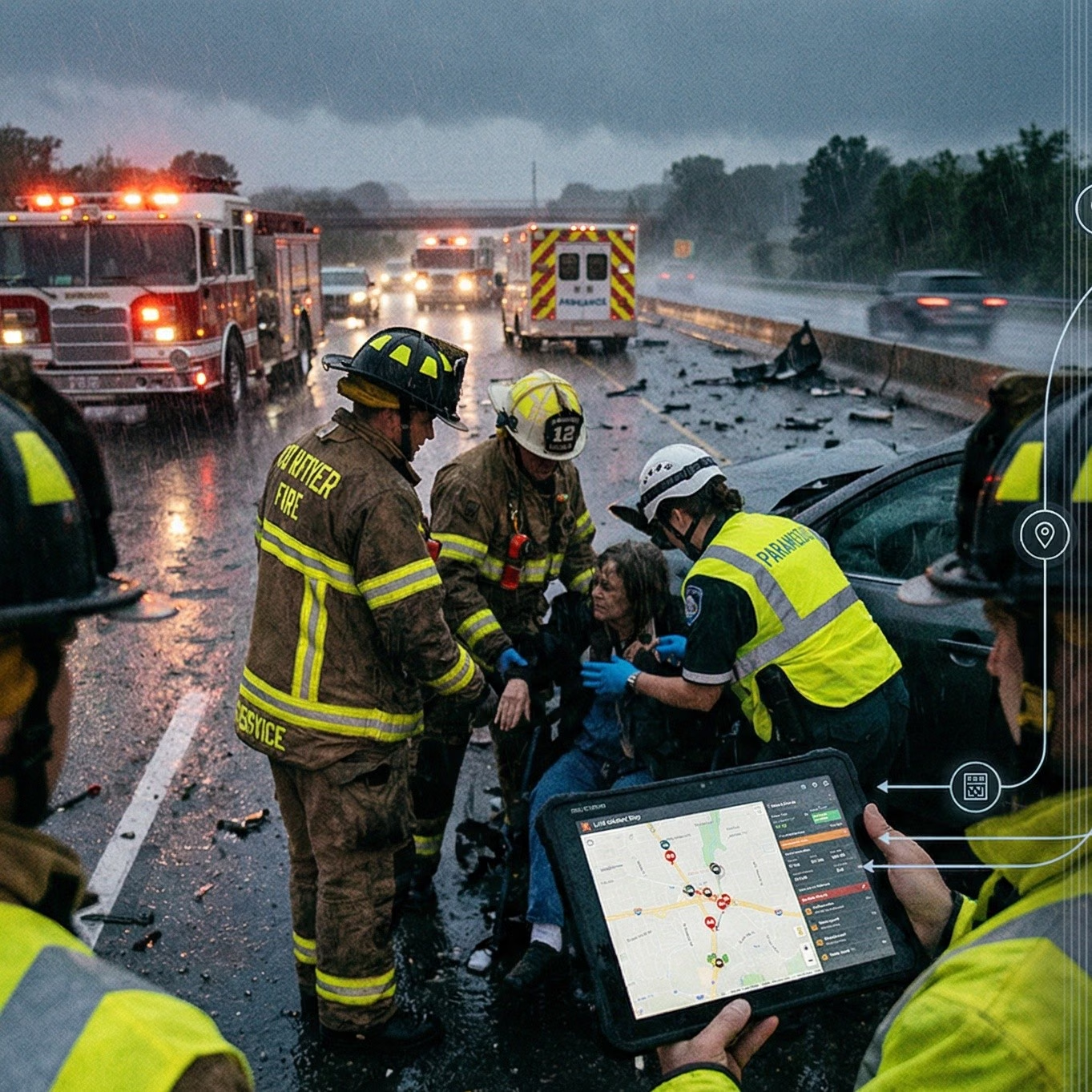
Missed part 1? Find it here: What Really Happens Inside Dispatch When an Incident Unfolds
Missed part 2? Find it here: Where Legacy Systems Break When It Matters Most
The most dangerous thing a dispatch system can do is fail when it’s needed most.
That may sound obvious, but in public safety it’s the difference between something being a helpful tool and something being critical infrastructure. Dispatch platforms aren’t optional. They sit at the center of coordination. When they slow down, fragment, or go offline under pressure, the entire response environment shifts.
Trust isn’t established in a controlled product presentation. It’s established when the platform continues to perform during high-stress, real-world scenarios.
A dispatch system has to perform on a quiet Tuesday afternoon when call volume is normal and everything feels manageable. It also has to perform when a tornado moves across multiple counties, when flooding impacts an entire region, or when call volume jumps from single digits to hundreds of active incidents. And it has to do that while the routine calls continue. Large-scale events don’t replace everyday emergencies. They stack on top of them.
Someone is still going to experience chest pains during a natural disaster. There will still be domestic disputes, vehicle crashes, and shoplifting calls while responders are stretched thin. Those incidents don’t become less urgent because overall volume is high. A system can’t afford to drop, delay, or lose visibility on them just because the environment is chaotic.
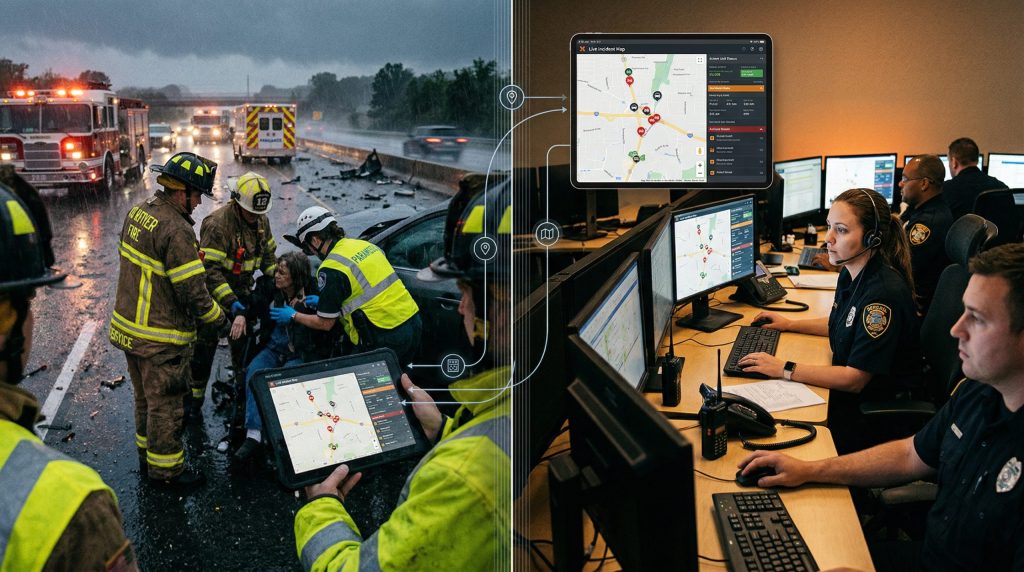
From an operator’s perspective, trust comes down to fundamentals. The system has to be accessible wherever personnel are working. Information has to update in real time without relying on manual steps that slow things down. When demand spikes, performance shouldn’t degrade or require emergency hardware upgrades just to keep up. And documentation has to remain clean and accurate so agencies can account for their actions later.
Agencies also need the opportunity to test a platform honestly before it becomes mission critical. Public safety professionals are naturally skeptical, and for good reason. Many have seen systems that looked polished during a presentation but struggled once deployed. Trust is built when users can configure the platform to match their environment, push it hard, and see how it performs before committing.
This is where modern cloud-based infrastructure changes expectations. Agencies don’t have to keep adding servers or expanding hardware to handle growth. Updates don’t mean scheduled downtime that forces a shift back to pen and paper. Performance doesn’t have to slow when call volume surges. The platform can scale with demand rather than forcing personnel to adjust to technical limits.
That philosophy is reflected in how 10-8 Systems approaches the problem. The focus isn’t on feature lists or comparison charts. It’s on building a dispatch platform that remains stable and responsive when operations become complex. Agencies are able to configure and test their own environment before going live, which reduces the gap between what’s demonstrated and what’s delivered. Scalability, uptime and interoperability are built into the architecture, not treated as optional add-ons.
For agencies evaluating modernization, the real question isn’t what a system can do on paper. It’s whether it will continue to function cleanly when call volume surges, when multiple jurisdictions are operating from the same incident, and when documentation may later be scrutinized.
Public safety professionals understand that perfection is not realistic. What they require is reliability. Agencies need systems that are steady on a quiet day and dependable during a crisis.
Technology will never replace trained professionals, but it can either support them under pressure or quietly work against them. The responsibility of a modern dispatch platform is to remove friction from coordination, not introduce it.
That is the standard today’s environment demands.