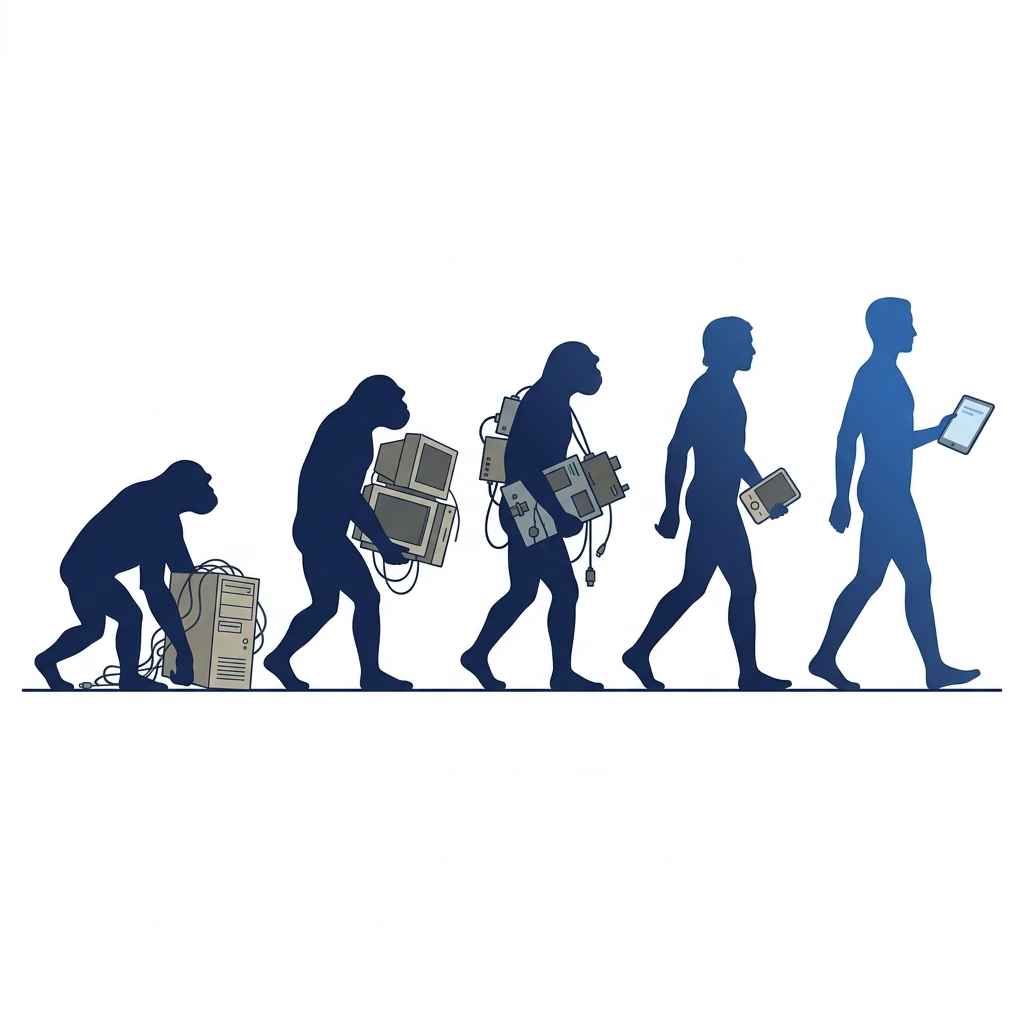
Most Computer-Aided Dispatch systems are more closely related than they look. Trace them back far enough and you find the same small group of people, one generation of designers and engineers rebuilding the same overcomplicated platform under different names, and that shared lineage explains most of what feels familiar about them. It is why so many look alike, feel alike, and demand an exorbitant number of unnecessary clicks to accomplish a single task, no matter whose logo is in the corner. The resemblance is not coincidence but inheritance, and it shows up on the console every shift.
The Common CAD Ancestor
The CAD family tree is smaller than the market makes it look. Most of the platforms agencies weigh today descend from the same few companies, and the same few design teams, who spun off, got acquired, and regrouped under new banners over the decades. They branched, but they never really evolved. The logos multiplied while the thinking underneath stayed put, and a few of these platforms never made it out of the cave. They are still taking those server-room assumptions to market as modern software.
Those assumptions come from a different era, back when software lived on a server in the building and CAD’s job was to store records rather than run a live incident. Screens were built around forms to fill out, and new capabilities piled up one bolted-on module at a time, until the workflow mapped the vendor’s history instead of the dispatcher’s job.
None of that was a bad idea at the time. But evolution rewards what adapts to the environment it’s actually in, and dispatch has moved on. A lot of these platforms haven’t.
 The Cost of Not Evolving
When a platform stops evolving, the cost of that doesn’t disappear. It lands on the dispatcher’s screen. Every workflow it never bothered to modernize becomes another step someone has to click through, and those steps pile up into a tax paid in clicks, in training time, and in cognitive load during the exact moments when there’s none to spare.
A dispatcher with more than twenty years on the console recently moved off an older system onto one where the tasks that used to take a dozen clicks now take three. Her reaction wasn’t that it was a nice feature. It was closer to disbelief that the work had been allowed to stay that hard for that long. A dozen clicks versus three is the whole story: one is what outdated software makes you do, the other is what a modern system lets you get on with.
That gap isn’t cosmetic. Under pressure, every extra step is one more place for an error to hide and one more second you don’t get back. This is the real line between a relic and a modern system: one makes the dispatcher work around it, the other works the way the dispatcher already does. That’s not a quirk you train around. It’s a cost you carry into every incident.
You shouldn’t have to change how you work to fit your software. It should have evolved past that by now.
A Demo Can’t Outrun Its DNA
A polished proposal can hide a lot. Agencies tell us some vendors turn up to an RFP with a document thick enough to bench-press, page after page engineered to say “you can trust us” without ever getting to how the thing actually works. The pitch is smooth, the demo is well rehearsed, and none of it tells you what the product does at two in the morning.
What matters shows up later, when the question turns from “does this look impressive” to “how will our people actually use this on a Tuesday night.” That’s where a dated platform gets exposed. A thick binder can dress up a weak product, but it can’t operate one. One agency told us the deciding factor wasn’t the size of the submission or how long the vendor had been around. It was the plain answer to how the work gets done. Paperwork hides a lot. The workflow hides nothing.
A good demo can dress a product up, but it can’t outrun the DNA underneath. A rehearsed pitch sits on top of the same old bones, and the family tree doesn’t get any younger because the slides look sharp. Sooner or later the product has to do the job, and that’s the part the song and dance was there to distract from.
Evolved, Not Iterated
You can’t iterate your way onto a different branch. A platform can add features, refresh its interface, and move its servers to someone else’s data center, but it’s still running on the same DNA it started with. Do that year after year and you will still have a platform that is fundamentally unchanged.
10-8 Systems didn’t descend from that line. It was built by first responders, cloud-native on AWS GovCloud from the first line of code, and organized around the live incident instead of the record. That starting point matters more than any single feature, because it means there’s no vestigial tail: none of the extra clicks, dead-end screens, and workarounds that survive only because some earlier version needed them. The platform carries what the job requires and nothing the lineage left behind.
What that buys an agency isn’t a longer feature list. It’s a system that keeps moving, continuously updated with no downtime, that adapts to how your people already work instead of asking them to adapt to it. The rest of the category is still refining the same old shape. This is what it looks like when something actually evolved to fit the environment it works in.
A Few Questions We Hear
Straight answers to what agencies ask us most.
QWhy do so many CAD systems feel the same?
Because most of them share a lineage. The same design teams and assumptions moved between vendors over the years, so the products came out with the same shape and the same clicks. When platforms come from the same place, they tend to end up in the same place.
QOur team has used the same system for years. Is a newer one hard to switch to?
It’s simpler to use, not harder to learn. The workflows are streamlined and the steps are fewer, so there’s less to pick up, not more. Teams coming off a heavier, older system are usually the quickest to feel the difference, because this one already works the way the job does.
QDoes modernizing our CAD mean replacing our people or ripping out our whole stack?
No. Think of it as adding better tools to the belt your team already carries, not taking anyone off the job. Modern CAD gives dispatchers and responders more to work with during live incidents. The people who know your operation are still the ones running it.
You shouldn’t have to settle for a platform that never left the cave. See what 10-8 Systems built instead: modern, cloud-native CAD designed around the way dispatch actually works. Meet us at APCO, or start a conversation any time.